Wendy's Shares Slip Below $7: Why Low Price Masks Deep Turnaround Challenges
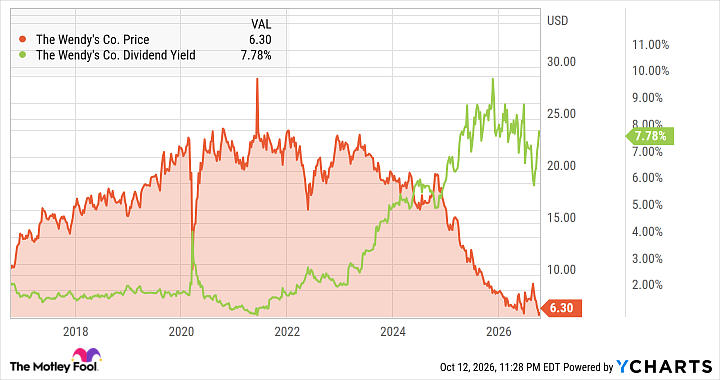
Wendy's (WEN) is trading just under **$7** a share, a price that sounds like a bargain but belies a complex set of operational and financial challenges. The fast‑food giant recently appointed turnaround specialist Todd Penegor as chief executive, tasking him with cleaning a kitchen riddled with legacy cost structures, tepid same‑store sales, and a market perception that the brand is stuck in a value‑trap. For investors, the immediate question is whether the sub‑$7 price tag reflects a genuine discount or a warning signal that the stock will continue to underperform the broader market.
The macro environment offers little relief. After a two‑year period of elevated inflation, consumer discretionary spending has softened, especially in the quick‑service segment where price‑sensitive diners gravitate toward value‑oriented competitors. At the same time, labor shortages and rising commodity costs have compressed margins across the industry. While the **S&P 500** has rallied roughly 12% year‑to‑date, Wendy's stock has lagged, declining about 18% and contributing to a widening gap with the benchmark. The **volatility index** (VIX) remains elevated, reflecting heightened uncertainty about consumer demand and the ability of legacy brands to adapt.
From a financial standpoint, Wendy's **market capitalization** hovers near **$5.6 billion**, a modest figure for a company with over 6,500 global locations. The chain reported fiscal‑year revenue of $2.1 billion, but growth was flat, and the **earnings per share** came in at $1.90, missing analyst expectations by $0.12. The resulting **price-to-earnings ratio** of roughly 8 is well below the **S&P 500** average of 22, suggesting the market is pricing in significant risk. Moreover, the company's free cash flow turned negative in the last quarter, raising concerns about its capacity to fund the aggressive menu simplification and digital modernization initiatives outlined in the latest investor deck.
Market repercussions are already evident. Institutional holders have trimmed exposure, and the stock’s beta has risen to 1.3, indicating heightened sensitivity to broader market swings. Hedge funds that specialize in distressed consumer equities have begun accumulating modest positions, betting that the turnaround narrative could unlock value if execution improves. Conversely, dividend‑seeking investors are staying away; Wendy's does not currently pay a dividend, and the lack of a clear path to sustainable cash generation makes the stock unattractive for income‑focused portfolios.
"The fundamental issue is not the share price itself but the structural headwinds that keep Wendy's earnings stuck in a low‑single‑digit growth zone," said **Morgan Stanley** senior analyst Laura Chen. "Until we see a clear lift in comparable sales and margin expansion, the stock will remain a risky play on the lower end of the **Wall Street** valuation spectrum."
Penegor’s strategic playbook centers on three pillars: menu optimization, digital acceleration, and cost discipline. The company plans to retire underperforming items, focusing on high‑margin core products like the Baconator and its newer plant‑based offerings. Digital ordering and delivery partnerships are being deepened to capture a larger share of the $150 billion U.S. quick‑service delivery market. Finally, a renewed emphasis on labor scheduling efficiency and supply‑chain renegotiations aims to shave roughly 150 basis points off operating expenses within 12 months.
Risks remain pronounced. Labor market tightness could force wage hikes that outpace revenue growth, eroding the modest margin improvements Penegor hopes to achieve. Additionally, the fast‑food sector is increasingly crowded, with chains like McDonald’s and Burger King leveraging scale to offer deeper discounts and more innovative menu items. Any misstep in the rollout of the new digital platform could also trigger customer attrition, further depressing same‑store sales.
Looking ahead, investors should monitor the upcoming Q4 earnings release, where management will disclose the first‑quarter impact of the menu overhaul and provide guidance on free cash flow. The rollout of a revamped loyalty program, slated for early 2027, could serve as a catalyst if it drives repeat visits and higher basket sizes. Finally, any shift in the **NASDAQ** or **Dow Jones** trends that lifts overall consumer confidence could indirectly benefit Wendy's by improving discretionary spend.
In sum, the sub‑$7 price tag is a superficial indicator that masks deep operational and financial challenges. While the new CEO brings a credible turnaround pedigree, the path to a meaningful valuation uplift is fraught with execution risk, competitive pressure, and macro‑economic uncertainty. Investors who can tolerate volatility may find upside potential, but the stock is unlikely to join the ranks of the market’s high‑flyers without a demonstrable shift in earnings trajectory.
© Kavam News 2026. All rights reserved.